
AI Search Optimization | Practical Guide
How to Optimize for AI Search Results in Google and ChatGPT
AI search visibility starts with strong SEO, clear answers, recognizable expertise, and evidence that search and answer systems can retrieve, understand, and trust.

Shaun Wilson
Fractional CMO and AI Search Strategist
Published May 24, 2025
•
Updated Aug 27, 2026
•
14 minute read
AI Search Optimization
Analysis by ClickIt CMO
The short answer
To improve visibility in Google AI Overviews, AI Mode, ChatGPT, and other answer systems, make important pages crawlable and indexable, answer real buyer questions clearly, establish who your business and experts are, support claims with evidence, and earn relevant third-party authority. AI search optimization is not a replacement for SEO. It is SEO expanded for how people now discover and evaluate information.
In This Article
How AI Search Finds Answers
The search experience is changing, but the underlying job is familiar: help a buyer find a useful, trustworthy answer and understand why your business belongs in the consideration set.
Google AI Overviews and AI Mode can assemble responses from information retrieved through Google Search. ChatGPT search and other answer systems can also retrieve current web content and cite supporting pages. The interfaces are different, but they all depend on accessible information, clear relevance, and signals that help the system judge whether a source is useful.
Google describes a process called query fan-out. The system may break a complex question into several related searches, retrieve pages across those subtopics, and build a more complete response. That creates an important opportunity. A page does not need to repeat every possible wording of a query. It needs to own a clear topic, answer the important parts well, and connect logically to supporting pages.
Google's official position
Foundational SEO still applies to generative AI search.
Google says AI Overviews and AI Mode are rooted in its core Search ranking and quality systems. A page must be indexed and eligible to appear with a snippet before it can be shown as a supporting link in these features.
This is why I do not treat AI search as a disconnected service. A weak technical foundation, thin content, unclear page ownership, or missing evidence will limit visibility in traditional results and AI-generated answers at the same time.
Build the Search Foundation First
Before chasing citations, confirm that search systems can access and interpret the pages that matter. The highest-value work often begins with ordinary SEO fundamentals:
- Crawlability and indexability: important pages are accessible to the crawlers you want, included in the sitemap, internally linked, and free from accidental noindex or canonical conflicts.
- Clear page ownership: one strong page owns each primary topic or intent, rather than several similar pages competing with one another.
- Descriptive titles and headings: the page clearly states what it covers and uses logical sections that help people scan the answer.
- Useful internal links: supporting pages connect related questions, services, evidence, and next steps without forcing the reader to hunt.
- Fast, accessible presentation: the content works on mobile, important text is present in the page, and images or videos support rather than replace the explanation.
- Accurate structured data: schema matches the visible content and clarifies relevant entities, authorship, services, articles, organizations, and local information.
Structured data can improve understanding and eligibility for certain search features, but it does not rescue weak content or guarantee an AI citation. It should describe what is genuinely on the page, not make claims the page cannot support.
Write Answer-First Content
Answer-first content respects the visitor's time. It gives a direct response near the beginning, then supplies the context, evidence, examples, limitations, and next step needed to make the answer useful.
Start with the real decision behind the query
A buyer searching “how much does SEO cost” may actually be trying to compare risk, scope, accountability, and expected value. A useful page should answer the literal question while also addressing the decision the person is trying to make.
Use a structure that can be understood out of context
Clear headings, concise definitions, short summaries, tables, steps, and descriptive captions make information easier for people to scan and easier for a retrieval system to isolate accurately. Each section should make sense on its own while still contributing to the page's larger argument.
Add what generic summaries cannot
Original examples, first-party data, named experience, screenshots, tested processes, client outcomes, and honest limitations give the page a reason to exist. Rewriting the same consensus answer found everywhere else creates little value for a reader and little reason for an answer system to cite your version.
Do not write for an imaginary robot. Write the clearest, most useful answer for the person making the decision, then make the evidence easy to retrieve and verify.
Shaun Wilson, ClickIt CMO
FAQs can help when they answer genuine follow-up questions. They should not be added simply to create more keyword variations. Google specifically warns against creating large numbers of pages or query variations to manipulate rankings or generative responses.
Make Expertise Easy to Verify
AI search visibility is partly an information-quality problem. Search and answer systems need enough context to understand who made a claim, what qualifies that person or organization to make it, and whether independent evidence supports it.
1
Name the source
Use clear authorship, a complete author profile, relevant credentials, real business information, and consistent organization details across the site.
2
Show the experience
Include examples, methodology, dates, photos, original analysis, and first-hand observations that demonstrate how the conclusion was reached.
3
Support important claims
Link to primary sources when possible. Distinguish verified facts from estimates, opinions, and client-specific outcomes.
4
Earn corroboration
Relevant mentions, citations, reviews, expert contributions, partnerships, and editorial links can help establish that other credible sources recognize the business or expertise.
Consistency matters. If the website, business profiles, author biographies, and third-party references describe the company differently, systems have a harder time connecting those facts to the same entity.
Google AI Search and ChatGPT Are Not Identical
There is no single universal AI-search ranking system. Google, ChatGPT, Bing Copilot, Perplexity, and other platforms use different indexes, retrieval partners, models, and citation rules. A sound strategy begins with the shared foundation, then verifies platform-specific access and performance.
Google AI Overviews and AI Mode
Google says there are no separate technical requirements beyond being indexed and eligible to appear in Search with a snippet. Core SEO, people-first content, strong page experience, and accurate structured data remain relevant. AI Mode and AI Overviews may use different models and techniques, so the pages cited can vary even for similar questions.
ChatGPT search
OpenAI says public websites can appear in ChatGPT search. To be included in summaries and snippets, a publisher should allow OAI-SearchBot to access the relevant content and ensure the host or security layer permits OpenAI's published crawler traffic. OpenAI also notes that referral links from ChatGPT search include a source parameter that can be tracked in analytics.
Bing and Copilot
Bing continues to emphasize crawl access, accurate sitemaps, freshness, and IndexNow. Bing Webmaster Tools also provides visibility into how content appears across Microsoft AI experiences, which can help identify cited pages and gaps.
Terminology without the alphabet soup
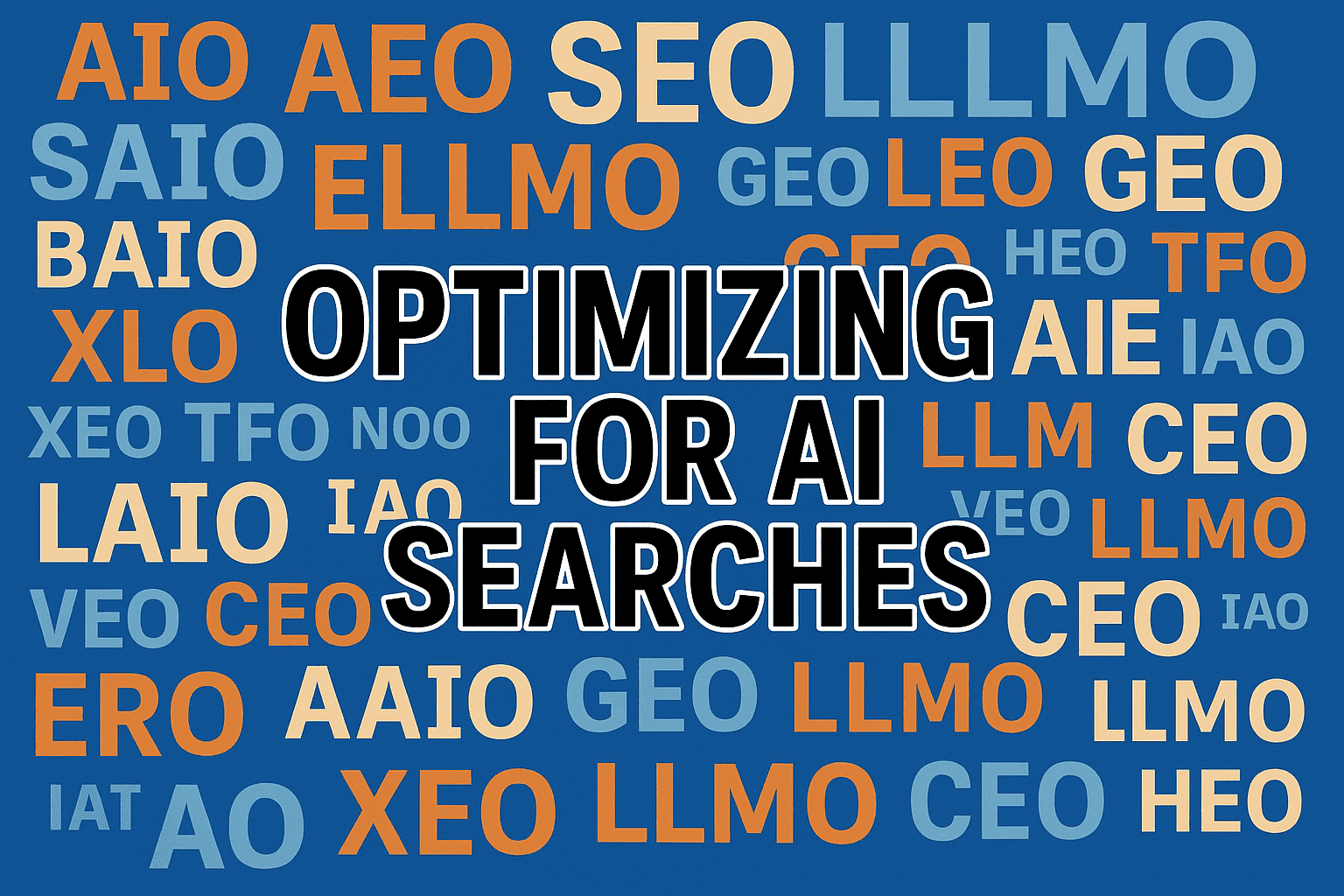
AEO, GEO, and LLMO describe areas of emphasis, not separate replacements for SEO.
AEO usually emphasizes direct answers. GEO emphasizes generative search experiences. LLMO emphasizes retrieval and mentions in large-language-model interfaces. Google explicitly treats optimization for its generative AI search features as part of SEO.
Measure Visibility and Business Outcomes
Rankings and organic clicks still matter, but they no longer tell the whole story. AI search can influence a buyer before a site visit, create a cited visit, or reinforce trust later in the journey. Measurement should combine discovery signals with business results.
- Search Console: monitor impressions, clicks, queries, page coverage, and whether refreshed pages are indexed.
- Analytics: review engaged sessions, qualified conversions, assisted paths, and referrals from AI platforms when identifiable.
- Citation monitoring: test a defined set of important buyer questions and record which brands and pages are cited over time.
- Entity consistency: audit how the business, services, experts, and claims are represented across owned and third-party sources.
- Business outcomes: connect organic and AI-influenced discovery to consultations, qualified leads, sales conversations, and revenue where tracking permits.
No responsible provider can guarantee an AI citation. The goal is to improve eligibility, relevance, clarity, and authority, then learn from what is actually being surfaced.
A Practical 90-Day Plan
1
Diagnose access and page ownership
Audit crawl controls, indexation, canonicals, sitemaps, internal links, duplicate intent, and the pages responsible for priority buyer questions.
2
Map buyer questions to evidence
Identify the questions that influence awareness, comparison, trust, and purchase. Match each question to a page, a credible answer, and supporting proof.
3
Strengthen priority pages
Improve answer placement, headings, examples, authorship, sources, structured data, internal links, calls to action, and conversion measurement.
4
Build and corroborate authority
Publish original insight, earn relevant mentions, improve expert profiles, and align business information across trusted sources.
5
Measure, test, and refine
Track indexing, search performance, identifiable AI referrals, citations for a controlled prompt set, qualified leads, and the next evidence gap.
Need a clear starting point?
An AI Visibility Audit can separate technical access problems, weak content ownership, entity ambiguity, and authority gaps so the work is prioritized around the business outcome.
Frequently Asked Questions
What is AI search optimization?
AI search optimization improves the ability of search and answer systems to discover, understand, retrieve, and cite a business's useful information. It combines technical SEO, answer-first content, entity clarity, structured data, authority development, and measurement. It is not simply writing content with AI.
Is AI search optimization different from SEO?
It is an expansion of SEO, not a replacement. Google states that its generative AI features are rooted in core Search ranking and quality systems. The same crawl, indexation, relevance, quality, and user-satisfaction foundations still matter, with additional attention to retrieval, citations, entities, and answer formats.
How do I appear in Google AI Overviews or AI Mode?
There is no special submission or guaranteed placement. The page must be indexed and eligible to appear in Google Search with a snippet. Strong technical SEO, useful people-first content, clear answers, accurate structured data, supporting media, and trustworthy evidence improve the foundation Google recommends.
How can my website appear in ChatGPT search?
OpenAI says public websites can appear in ChatGPT search. Allow OAI-SearchBot to crawl the relevant pages, make sure your host or security layer permits its published IP ranges, and publish information that is clear, current, and worth citing. Inclusion or placement is not guaranteed.
Do I need separate AEO, GEO, and LLMO strategies?
Usually not. These terms emphasize different parts of a connected search strategy. Start with one technical, content, entity, authority, and measurement foundation. Add platform-specific checks only where the systems have genuinely different access controls or reporting.
Can schema guarantee an AI citation?
No. Structured data can help systems understand eligible information, but it must match the visible page and it cannot guarantee indexing, rankings, or citations. The content and underlying evidence still have to be useful and trustworthy.
How long does AI search optimization take?
Technical fixes can be implemented quickly, but recrawling, reindexing, authority development, and citation patterns take time. A useful first phase is often 60 to 90 days of diagnosis, priority-page improvements, measurement, and evidence building, followed by continuous refinement.
Sources and Further Reading
About the author
Shaun Wilson
Shaun is the founder of ClickIt CMO, a Fractional CMO and AI Search Strategist with 15+ years of experience across SEO, paid search, content, analytics, conversion, and full-funnel digital marketing. Clients work directly with Shaun for the strategy, judgment, and hands-on execution.
A practical next step
Tell Shaun Where Growth Is Getting Stuck
Share what you sell, who you need to reach, and what is not working. Shaun will review the opportunity personally and help identify the most useful next step.